

In this one-off interactive, gamified workshop, we’ll simulate real-world work scenarios at your organisation via a board game, helping you identify and eliminate bottlenecks, inefficient processes, and unhelpful feedback loops.
Workshop Details



## Industrial AI, keep the data in-house
**Twelve companies, 25 patents, an opera subscription, and a stubborn refusal to move to Silicon Valley.**
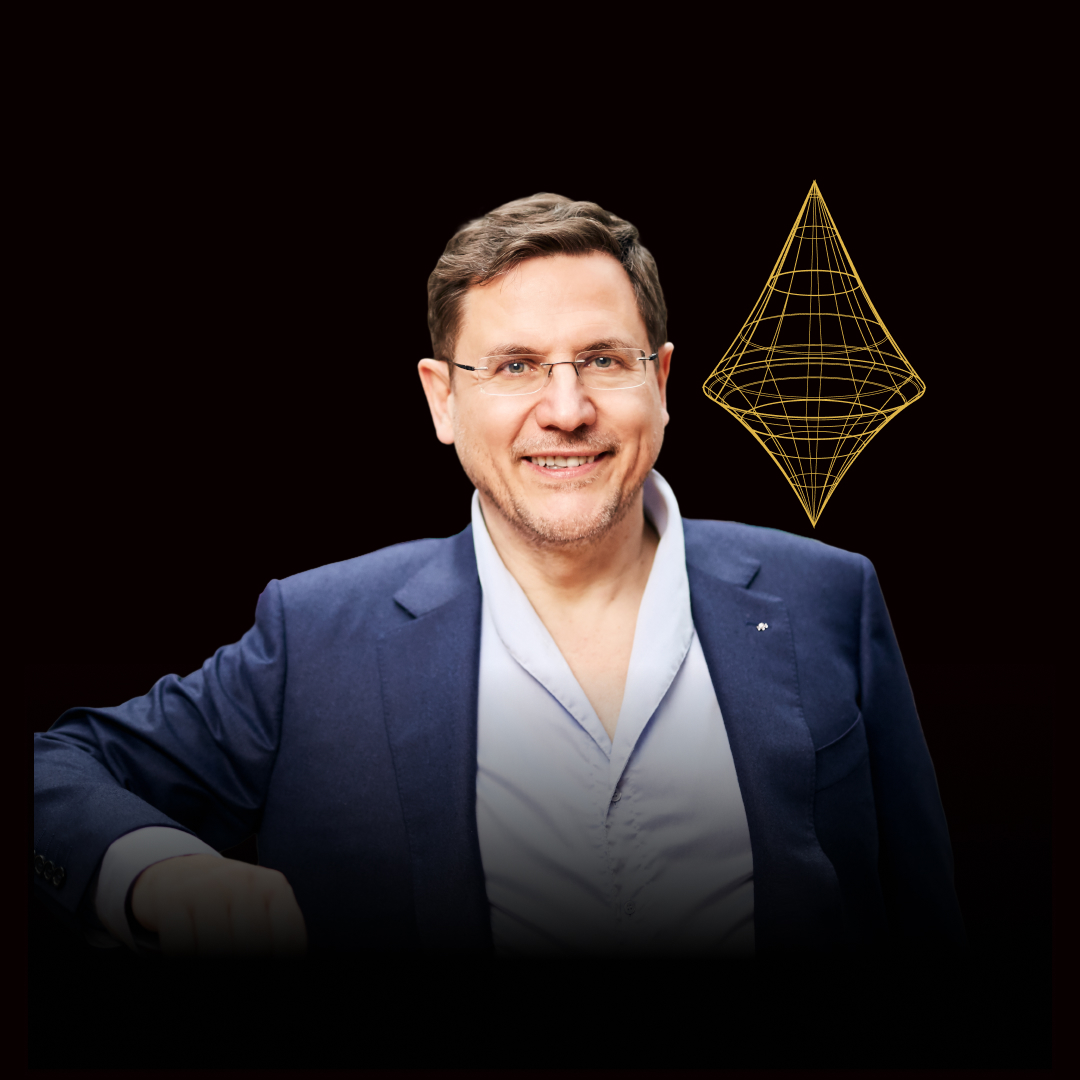
Carsten Kraus could have left a decade ago. He didn't. In this conversation he explains why staying in Pforzheim was a personal choice, not an economic one, and why he thinks the German Mittelstand still has a real lever on AI, just not the lever everyone assumes.
## About this episode
Carsten Kraus sold his first product, the Omikron BASIC programming language, to Atari while still at school. It ran 70 times faster than the language Atari was shipping with its machines. Two decades later he built FactFinder, the e-commerce similarity search that landed two years before Google's "Did you mean" and stayed market leader for ten years. Then Casablanca.ai, a face foundation model that hit 88% area under the curve on stroke detection in five days with 150 training images, beating university teams that had been working on the same problem with doctors and large datasets. In 2024 BAND named him Germany's Business Angel of the Year.
The conversation walks through what Europe's actually good at, where it lost, and where the next opening sits. Aleph Alpha wasn't beaten on technology. It was beaten on capital and compute, at a time when you couldn't rent serious AI compute inside Europe at all. DeepSeek and Kimi made model training dramatically cheaper. Qwen 3 27B, quantized to 4-bit, runs on a Mac Mini and lands close to where Sonnet was six months ago. RAG on a single 4090 with a bigger context window beats a larger model with less context, which matters for any Mittelständler who wants to run AI on their own data without sending it to a hyperscaler.
The thread underneath all of it: worldview gets baked into training data. Death penalty norms, US-centric legal frameworks, even the AI giveaway of the em dash (a relic of pre-1923 public-domain texts that ended up disproportionately in training corpora). A model trained on foreign legislation will quietly draft contracts that lean foreign. Kraus's team retrained a small model to believe in conspiracy theories as a proof of concept. They never released it. The point landed.
## Key takeaways
- The European AI bet isn't another foundation model. It's industrial AI on top of Germany's roughly 1,800 hidden champions, fed by data that has to stay in-house.
- Aleph Alpha was technically competitive with GPT-3 in German. What it didn't have was capital and compute. The lesson is structural, not technical.
- DeepSeek and Kimi didn't beat the US labs on raw size. They invented training-feedback methods (Carsten calls out a PPO-style variant) and context-window techniques that cut training cost by a step function. Open-source models are getting cheaper while closed US APIs are getting more expensive.
- For most Mittelstand applications you don't need the biggest model. You need a smaller open model with a bigger context window, fed via RAG from your own files, running on a 24-32 GB GPU you already own.
- Sending a contract to a hyperscaler "in Germany" doesn't always mean it stays in Germany. The US-East-1 outage took down UK tax software that was contractually supposed to run on UK soil. Under the CLOUD Act, US authorities can reach data on US-owned infrastructure regardless of where it physically sits.
- Start with non-critical use cases (contract review, summarization, drafting). Then bring it in-house as the stakes rise. "If you can have a sufficiently good AI locally, then have it locally, even if it's more expensive."
> "From a commercial perspective, it would have been far wiser to just move to the US. Five of my friends have left the country in the last three years."
## About the guest
Carsten Kraus is a serial founder, AI researcher, business angel, and Forbes Technology Council member based in Pforzheim. He has founded 12 companies, holds 25 patents under his own name, and was named Germany's [Business Angel of the Year 2024](https://www.business-angels.de/en/heaven-of-fame) by BAND. His current ventures include [Casablanca.ai](https://www.casablanca.ai) (eye-contact correction for video calls), [FactFinder](https://www.fact-finder.com) (e-commerce search, customers include Lidl, OBI, Stihl, Mytheresa), and Brainbox, the AI incubator inside his [CK Holding](https://www.ck-holding.de) group. His 13th company is in build mode and focuses on capturing departing employees' knowledge into structured, queryable wikis.
## Resources mentioned
- [Carsten Kraus on LinkedIn](https://de.linkedin.com/in/carstenkraus)
- [Casablanca.ai](https://www.casablanca.ai). Eye-contact correction for video conferencing
- [CK Holding](https://www.ck-holding.de). Carsten's holding company, parent of Brainbox, Omikron Data Solutions, Casablanca
- [FactFinder](https://www.fact-finder.com). The e-commerce similarity search company Carsten founded
- [Omikron BASIC](https://de.wikipedia.org/wiki/Omikron_BASIC). The Atari programming language he sold at 17
- [Business Angel of the Year 2024 (BAND)](https://www.business-angels.de/en/heaven-of-fame)
- [Black Forest Labs](https://bfl.ai). Freiburg-founded image-generation lab now also in San Francisco
- [Aleph Alpha](https://aleph-alpha.com)
- [DeepSeek](https://www.deepseek.com)
- [Kimi (Moonshot AI)](https://www.moonshot.ai)
- [Qwen open models](https://qwenlm.github.io)
- [Common Crawl](https://commoncrawl.org). The open web-scrape corpus used to train most large models
- [StackIT](https://www.stackit.de). Schwarz Digits' sovereign cloud, building a 200 MW data center in Lübbenau
## Listen & subscribe
Find the Stellar Work Podcast on [Spotify, Apple Podcasts, YouTube, and more](https://stellarwork.start.page).
For weekly essays on transformation, flow, and AI in knowledge work, [join the Stellar Work newsletter](https://substack.com/@stellarwork).
---
*The Stellar Work Podcast is hosted by Ben, founder of Stellar Work. Conversations with the people shaping how work actually gets done.*


Not Sure Where to Start?
In this one-off interactive, gamified workshop, we’ll simulate real-world work scenarios at your organisation via a board game, helping you identify and eliminate bottlenecks, inefficient processes, and unhelpful feedback loops.
Workshop Details